
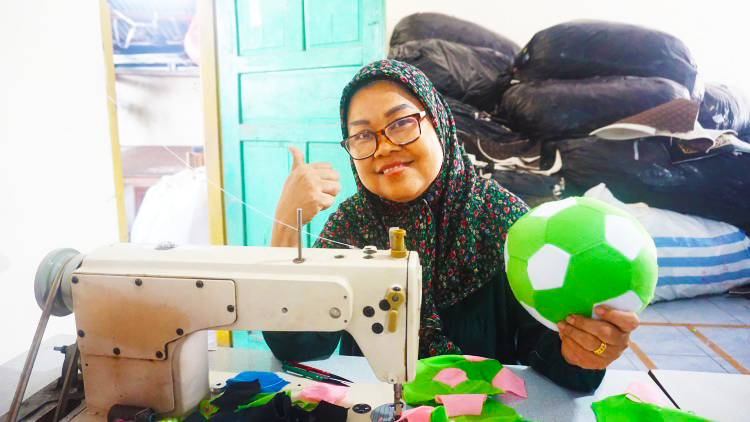
For Samih, learning to sew was more than an opportunity to acquire a new skill. It became a way to return to work, contribute to her household income, and create opportunities for people around her.
At the time of the program in 2023, Samih was 48 years old and living with her husband and youngest child in Bekasi. A mother of four, she spent much of her time caring for her grandchild and managing the household. Her husband supported the family through irregular work, including construction jobs.
Samih had previously worked for a printing company, a shoe factory, and a household-goods manufacturer. However, when her last employer closed in 2016, she lost her job and eventually became a full-time homemaker.
As she grew older, Samih felt that returning to factory employment would be increasingly difficult. What she wanted was an opportunity to work from home while continuing to fulfil her family responsibilities.
That opportunity began when a neighbour told her about a doll-sewing course organized by Yayasan Inspirasi Indonesia Membangun (YIIM) and PT Insight Investments Management in collaboration with the Bekasi City BKMM Islamic Study Group Network.
Samih enrolled in the ten-day course with determination. She started with limited sewing experience but approached every lesson with enthusiasm, hoping that the skills would open a realistic pathway to home-based work.
“I had always wanted to work from home. The training gave me sewing skills and new knowledge,” Samih recalled.
The transition from training to employment happened quickly. During the course, Rokhmat—the instructor and owner of CV Diah Mandiri Toy’s—offered participants an opportunity to take on paid sewing work after completing their training.
Motivated to begin, Samih and her child spent an entire day searching for an affordable second-hand sewing machine. Once they found one that worked, she had the essential equipment needed to turn her newly acquired skills into income.
Her first assignment involved sewing 1,100 election stamp pads ordered by Indonesia’s General Elections Commission. Rather than completing the order alone, Samih invited six unemployed women from her neighbourhood to work alongside her.
The experience demonstrates how one participant’s skills can create benefits beyond the individual. Samih’s first job provided her with an income while also opening short-term livelihood opportunities for other women in her community.
The work was not immediately easy. Some of Samih’s early pieces required correction, but she continued practising and sought guidance from her instructor and fellow participants. Through repetition, feedback, and persistence, her sewing became faster and more consistent.
Within two weeks, Samih was producing approximately 120 pieces a day and completing around 840 pieces per week. She was paid Rp300 for each completed piece, giving her a new source of household income shortly after the training ended.
For Samih, the value of the income extended beyond its amount. It allowed her to contribute towards daily household expenses and reduced her dependence on her husband and children.
Her story illustrates the importance of connecting vocational training with genuine opportunities to apply new skills. The course did not end with a certificate: it gave Samih access to a work network, practical experience, and an immediate pathway to earning.
It also shows how economic empowerment can spread through a community. By sharing the assignment with six neighbours, Samih became more than a training graduate. She became someone capable of extending opportunity to others.
Samih hopes to continue improving her sewing skills and maintaining the work as a reliable source of income. What began with a neighbour’s information, a free training opportunity, and a second-hand sewing machine has become a meaningful step towards greater independence.
Her journey reflects a simple but important measure of impact: a skill learned, a livelihood started, and an opportunity shared.
Salam Inspirasi!

Leave A Comment